
Gaited Horses: What They Are, the Best Breeds and What They Cost
What is a gaited horse? The main gaited horse breeds, from Fox Trotters and Walking Horses to Rocky Mountain Horses and Paso Finos, with each breed's gait and US prices.
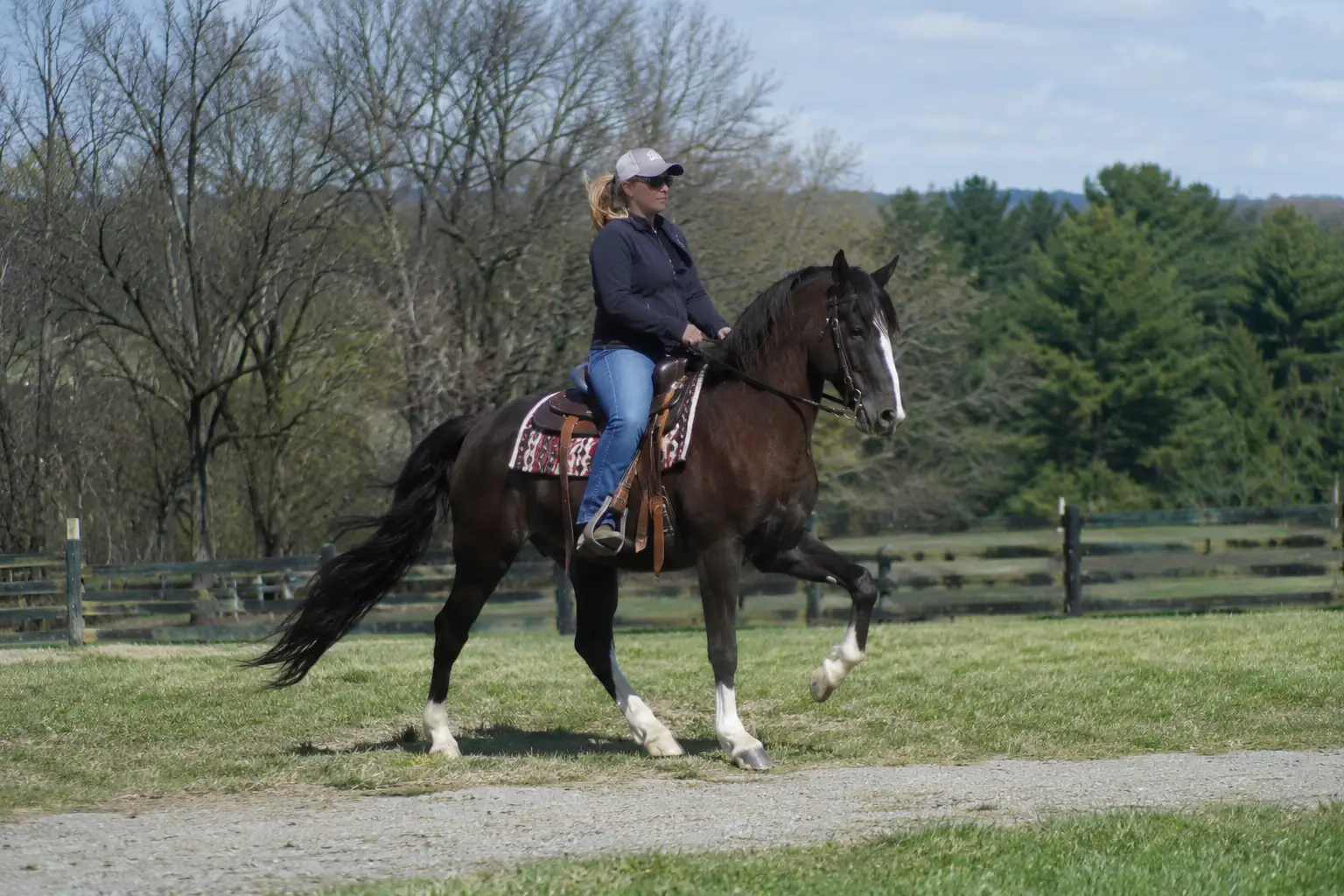
What Is a Gaited Horse?
A gaited horse is a horse that naturally performs a smooth intermediate gait, such as the running walk, fox trot, rack or paso gait, in place of or as well as the trot. In these gaits the legs do not move in matched pairs, so the horse usually keeps more feet on the ground at once and the rider feels far less bounce. The best-known gaited horse breeds in the US are the Tennessee Walking Horse, Missouri Fox Trotter, Rocky Mountain Horse, Racking Horse, Spotted Saddle Horse and Paso Fino.
Gaited horses are also affordable. In November 2026, the median asking price for the main gaited breeds listed on a national US marketplace ran from about $5,000 to $8,500.
Key Takeaways
Smoother ride: gaited breeds move with an intermediate gait in which the legs do not pair, which University of Florida extension researchers describe as the main characteristic of a smooth-gaited horse.
Many breeds, one idea: each breed has its own signature gait, from the Fox Trotter's fox trot to the Paso Fino's three-speed paso gait.
Popular for trail riding, because the smooth gait is comfortable for long hours in the saddle.
Typical US asking prices: median about $6,000 for Tennessee Walking Horses, $6,500 for Missouri Fox Trotters and $8,500 for Rocky Mountain Horses.
Test the gait yourself before you buy, and choose on temperament and training, not the gait alone.
How Gaited Horses Move
Most horses have three natural gaits: the walk, the trot and the canter. In the trot the legs move in diagonal pairs, which produces the bounce riders learn to post to. Gaited horses add, or swap in, an intermediate gait in which the legs do not move in pairs. A University of Florida extension publication on gait genetics explains that gaited breeds are prized for intermediate patterns "in which the legs do not pair completely", and that this lack of synchronization is the main characteristic of a smooth-gaited horse. Much of the rider's comfort comes from moments of "triple support", when three feet are on the ground at once.
Different breeds have different names for their gaits, and some gaits are inherited and natural while others are refined with training. When you see an ad for a gaited horse, ask which gait it performs and see it under saddle.
Gaited vs. non-gaited horses
Ride: a gaited horse is usually smoother to sit at speed; a trotting horse bounces more.
Uses: gaited horses are especially popular for trail riding and pleasure riding; non-gaited breeds dominate disciplines such as reining, cutting, jumping and dressage.
Training: a gaited horse may need a rider who knows how to ask for and keep its gait, and tack such as a saddle that fits it well.
The Main Gaited Horse Breeds
Missouri Fox Trotter
The Missouri Fox Trotter dates back to the early 1800s, when settlers in the Ozark Mountains needed a horse that could carry them comfortably over rough country. Its breed association, the Missouri Fox Trotting Horse Breed Association, was founded in 1948, and Missouri named the Fox Trotter its state horse in 2002. The breed's signature fox trot is a broken diagonal gait: the horse moves its front foot a split second before the opposite hind foot and never has more than two feet off the ground at once. See Missouri Fox Trotters for sale.
Tennessee Walking Horse
The Tennessee Walking Horse, developed in Tennessee, is best known for its smooth running walk and is one of the most popular gaited breeds in the US. It is widely used for trail and pleasure riding as well as showing. With 346 Tennessee Walking Horses listed on the national marketplace we reviewed, it was also the most widely advertised gaited breed. See Tennessee Walking Horses for sale.
Rocky Mountain Horse
Despite its name, the Rocky Mountain Horse comes from Kentucky. Its breed association was registered in Kentucky in 1986, and the breed standard calls for a smooth four-beat ambling gait, a gentle temperament, a height of 14 to 16 hands and a solid body color. Many buyers look for the chocolate coat with a flaxen mane and tail. Our Rocky Mountain Horse price guide covers prices in detail, and Equine Listings has a large selection of Rocky Mountain Horses for sale.
Racking Horse
The rack is often called the single-foot, because a single foot strikes the ground at a time. According to the Racking Horse Breeders' Association of America, the breed's ancestors were first bred on southern plantations before the American Civil War, and enthusiasts formed their own breed association in 1971 in Decatur, Alabama. The Racking Horse is prized for speed as well as smoothness.
Spotted Saddle Horse
The Spotted Saddle Horse combines a smooth gait with a pinto coat. To register with the National Spotted Saddle Horse Association, a horse must be spotted, with color above the hock other than facial markings, and must perform a gait other than a trot: a stepping pace, a rack or another saddle gait is accepted. The association registers horses foaled from 1979, when it began.
Paso Fino
The Paso Fino traces back more than 500 years to Spanish horses brought to the Americas by the Conquistadors, and the breed first flourished in Puerto Rico and Colombia. Its smooth four-beat gait is performed at three speeds: the classic fino, with full collection and very slow forward speed; the paso corto, at moderate speed; and the paso largo, the fastest. The breed standard gives a size of 13 to 15.2 hands, with 13.3 to 14.2 hands most typical, and the Paso Fino Horse Association traces its beginnings to a meeting in 1972.
How Much Do Gaited Horses Cost?
We read the listings for each breed on DreamHorse, a national US horse marketplace, on 16 November 2026. Each line shows the median asking price and the middle half of priced ads.
Rocky Mountain Horse (76 priced ads): median about $8,500, middle half about $6,400 to $13,000.
Missouri Fox Trotter (93 priced ads): median about $6,500, middle half about $4,500 to $10,000, top ads about $20,000.
Tennessee Walking Horse (203 priced ads): median about $6,000, middle half about $4,000 to $8,500, top ads about $25,000.
Spotted Saddle Horse (22 priced ads): median about $5,000, middle half about $3,500 to $6,900.
Paso Fino (15 priced ads): median about $5,000, middle half about $3,700 to $8,500. This is a small sample.
Racking Horse: too few priced ads (5) for a reliable figure.
For comparison, the median Quarter Horse in our Quarter Horse price guide and the median Andalusian in our Andalusian price guide both asked more than any gaited breed above.
Are Gaited Horses Good for Trail Riding?
Yes, and trail riding is where many gaited horses shine. The smooth gait lets riders cover ground for hours with less fatigue, which is why gaited breeds are popular with trail riders and older riders. Look for a horse that holds its gait on uneven ground and over hills, not only in an arena, and that is calm around traffic, water and other horses. Browse gaited horses for sale on Equine Listings.
Are Gaited Horses Good for Beginners?
Many gaited horses suit beginners, because the smooth gait is easy to sit and several breeds are known for a calm temperament. As with any breed, the individual horse matters most. A young or green gaited horse is not a beginner horse: see our guides to beginner-safe horses and green, started and finished horses.
What to Check Before Buying a Gaited Horse
Ride the gait yourself at different speeds, on flat ground and on a trail, and ask for video.
Ask which gait the horse performs and whether it is natural or the result of training.
Check saddle fit. Gaited horses move their shoulders freely, so a saddle that fits matters.
Ask how the horse is shod and whether it needs special shoeing to hold its gait.
Have a veterinarian examine the horse. Our pre-purchase exam guide explains what it covers.
Put the sale in writing. See what an equine bill of sale must include.
Frequently Asked Questions About Gaited Horses
A gaited horse naturally performs a smooth intermediate gait, such as the running walk, fox trot, rack or paso gait, in place of or as well as the trot. Its legs do not move in matched pairs, so the ride is far smoother than a trot.
The Bottom Line on Gaited Horses
Gaited horses replace or add to the bouncy trot with a smooth intermediate gait, which makes them favorites for trail and pleasure riding. The main US breeds are affordable, with median asking prices of about $5,000 to $8,500. Ride the gait yourself, check saddle fit and shoeing, have a veterinarian examine the horse, and choose on temperament and training first.
Looking for a gaited horse?
Browse gaited horses for sale on Equine Listings, including Rocky Mountain Horses, Tennessee Walkers and Fox Trotters.
Sources
University of Florida IFAS Extension, Genetic Selection for Gaits in the Horse (AN332)
Missouri Fox Trotting Horse Breed Association, Gaits, History of the Breed and MFTHBA History
Rocky Mountain Horse Association, Breed Standard and Association History
Racking Horse Breeders' Association of America, rackinghorse.org
National Spotted Saddle Horse Association, Registration
Paso Fino Horse Association, The Gaits, History, Breed Standard and 50th anniversary
DreamHorse breed listings for Tennessee Walking Horses, Missouri Fox Trotters, Rocky Mountain Horses, [Spotted Saddle Horses](https://www.dreamhorse.com/b/44